7 Things to Check Before Buying a Microwave Stand Online
Share
A microwave is one of the most frequently used appliances in many Indian kitchens. From reheating meals and preparing quick snacks to defrosting ingredients, it makes everyday cooking more convenient.
But finding the right place for a microwave can sometimes be challenging, especially in kitchens where countertop space is already occupied by mixers, kettles, toasters, air fryers, and other appliances.
A microwave stand can help create a dedicated space for your appliance while making better use of the available kitchen area.
However, not every microwave stand offers the same stability, storage capacity, durability, or convenience.
When shopping online, it's easy to focus on appearance and price while overlooking practical details that can make a significant difference after installation.
Before buying a microwave stand, here are seven important things you should check to ensure you're choosing a product that suits your kitchen and everyday needs.
1. Check the Frame Material and Build Quality
The first thing to examine is the construction of the microwave stand.
A microwave is relatively heavy, and the stand must support its weight safely while remaining stable during everyday use.
Microwave stands are commonly made using materials such as metal, engineered wood, or a combination of both.
Metal frame microwave stands
Metal frames can offer good structural strength when properly designed and assembled.
Powder-coated iron or steel frames are particularly popular for kitchen storage furniture because the coating provides a protective finish and a clean appearance.
However, the quality of the metal, frame design, welding, joints, and overall construction are equally important.
A metal stand is not automatically stronger simply because it is made of iron or steel.
Wooden and engineered wood stands
Wooden and engineered wood microwave stands can complement kitchen interiors, especially when they match existing cabinets and countertops.
However, their performance depends on the board quality, thickness, edge finishing, moisture protection, and construction.
Kitchens are exposed to humidity, occasional spills, and frequent cleaning, so surface maintenance should also be considered.
What should you look for?
Before purchasing, check whether the product listing clearly mentions:
- Frame material and finish
- Shelf material
- Construction and assembly method
- Recommended load capacity
- Cleaning and maintenance requirements
Buying tip: Choose a microwave stand with clearly explained construction details rather than relying only on attractive product photographs.
2. Check Stability and Weight Capacity
A microwave stand should feel stable during regular use.
Opening and closing the microwave door, placing items on shelves, and using storage drawers all create small movements and forces.
A poorly designed stand may wobble, particularly when loaded.
Understand weight capacity
Different microwave stands support different loads.
Some lightweight racks are intended mainly for small accessories, while sturdier designs may accommodate heavier kitchen appliances.
Before buying, compare the microwave's actual weight with the manufacturer's stated capacity for the specific shelf or platform where it will sit.
Remember that load capacity is not necessarily the same for every shelf.
For example, a stand may have a different load rating for its top shelf, microwave platform, and drawer.
Look at the overall structure
A stable microwave stand should have:
- A well-supported frame
- Secure shelf connections
- Appropriate weight distribution
- Properly fitted fasteners
- A design suitable for its intended load
Also consider the surface where the stand will be placed.
Even a well-built stand may wobble on an uneven floor or countertop.
Why weight distribution matters
Heavy appliances should only be placed on shelves specifically designed to support them.
Placing excessive weight on an upper shelf can affect stability, particularly if the stand is tall or narrow.
Always follow the manufacturer's loading instructions.
Buying tip: Avoid microwave stands that do not provide sufficient information about load capacity or intended appliance placement.
3. Check Whether the Stand Provides Useful Storage
A microwave stand should do more than simply hold your microwave.
One of the main reasons people purchase a separate stand is to improve kitchen organisation.
However, not every storage feature is equally useful.
Some stands offer multiple narrow shelves that look attractive in photographs but may not accommodate the appliances or accessories you actually own.
Before buying, consider how you plan to use the available space.
A microwave platform
The main platform should comfortably accommodate your microwave while allowing the ventilation and clearance specified by its manufacturer.
The platform should also provide appropriate support for the microwave's feet.
An additional top shelf
A top shelf can be useful for storing items such as:
- Tea and coffee accessories
- Cups and mugs
- Lightweight storage containers
- Small kitchen accessories
- Other suitable items within the shelf's rated capacity
If you plan to place another appliance on the top shelf, check its weight, dimensions, operating clearance, and ventilation requirements first.
A built-in drawer
A microwave stand with a drawer provides enclosed storage for smaller kitchen essentials.
This can be particularly useful for items that otherwise remain scattered across the countertop.
For example, a drawer can hold oven mitts, measuring spoons, napkins, food clips, manuals, and other appropriate accessories.
Unlike open shelves, drawers also help keep smaller items out of sight.
Open shelves vs enclosed storage
Open shelves make frequently used items easy to access.
Drawers help organise smaller objects and reduce visible clutter.
A combination of both can offer greater flexibility than a stand designed only to hold one appliance.
Buying tip: Think about what you actually need to store before choosing a stand with multiple compartments.
4. Check the Dimensions and Microwave Compatibility
One of the most common mistakes when purchasing a microwave stand online is assuming that all microwaves with the same litre capacity have similar dimensions.
For example, two 23-litre microwave ovens may have different external widths, depths, and heights.
This means a stand advertised as suitable for a particular microwave capacity may not necessarily fit every model in that category.
Measure your microwave first
Before purchasing, measure the external dimensions of your microwave.
Pay attention to:
Width: Measure from one outer side of the microwave to the other.
Depth: Measure from the front to the back, including any protruding parts that affect placement.
Height: Measure from the bottom of the appliance to its highest point.
You should also check the position of the microwave's feet and ensure the supporting platform can accommodate them.
Don't forget ventilation
Microwave ovens require adequate ventilation during operation.
The necessary clearance varies by model, so always consult your microwave manufacturer's installation instructions.
Do not assume that a microwave will be safe to operate simply because it physically fits inside a stand.
Check the available kitchen space
Measure the area where you intend to place the stand.
Consider:
- Total width and depth
- Overall height
- Nearby cabinets and walls
- Microwave door opening
- Access to the power socket
- Safe movement around the appliance
If your kitchen has limited space, also check whether the stand will obstruct drawers, cabinet doors, or walking areas.
For a more detailed explanation, read our Microwave Rack Size Guide: How to Measure Your Microwave Before Buying a Stand.
Buying tip: Always compare actual appliance dimensions with the stand's usable platform dimensions rather than relying only on litre capacity.
5. Check the Assembly Process
Many microwave stands sold online are delivered in flat-pack form.
This can make transportation and handling easier, but it also means the product must be assembled before use.
Before ordering, find out what the assembly process involves.
Questions worth asking
Does the product include assembly instructions?
Are all the required fasteners and components supplied?
Are any additional tools needed?
Can the stand be assembled at home, or does it require professional installation?
Does the seller provide an assembly demonstration or video?
These details can make a significant difference to the overall buying experience.
Why assembly quality matters
Even a well-designed stand may become unstable if assembled incorrectly.
Loose screws, improperly fitted shelves, or incorrectly positioned components can affect the structure.
Always follow the assembly instructions and check that all fasteners are secure before placing your microwave on the stand.
If the product includes a drawer, ensure it opens and closes smoothly after assembly.
Consider future maintenance
A practical microwave stand should also be reasonably easy to clean and maintain.
Look for surfaces that can be wiped down conveniently and a design that allows you to access areas where dust or food particles may accumulate.
Buying tip: An assembly video is a useful sign that the seller has considered the customer's installation experience.
6. Check Delivery, Packaging, and After-Sales Support
When purchasing furniture or kitchen storage products online, the buying experience doesn't end at checkout.
Packaging, delivery, and after-sales assistance are important, especially for products containing metal frames, laminated shelves, or other components that could be damaged in transit.
Packaging quality
A microwave stand may contain several separate parts.
These should be packed to reduce movement and protect edges, corners, and finished surfaces during transportation.
Check whether the seller provides information about how the product is packaged.
Delivery coverage
Before ordering, verify whether the product can be delivered to your location.
Also check the estimated delivery time and any additional shipping charges.
Large or heavy kitchen storage products may have different delivery conditions from smaller household accessories.
Replacement and damage policies
Read the seller's return, replacement, and damage-reporting policies carefully.
Pay particular attention to:
- Transit damage procedures
- Missing component support
- Reporting deadlines
- Replacement eligibility
- Assembly-related support
Policies vary between sellers, so it is better to understand them before purchasing.
Customer reviews
Customer photographs and detailed reviews can help you understand how a microwave stand performs in real kitchens.
Look for feedback about assembly, stability, finish quality, packaging, and everyday usability.
Buying tip: Don't judge a product only by its star rating. Read the details of customer experiences wherever genuine reviews are available.
7. Compare Overall Value, Not Just the Price
When shopping online, it is tempting to choose the least expensive microwave stand available.
However, the cheapest option is not always the most suitable choice for your kitchen.
Two stands may look similar in photographs while differing considerably in their materials, storage features, construction, and usability.
Compare what you're getting
Before making a decision, consider:
Construction: Is the frame designed to support your intended appliances?
Storage: Does the stand provide useful additional space?
Dimensions: Will it fit your microwave and the available kitchen area?
Finish: Is the material appropriate for regular kitchen use?
Assembly: Can you install it correctly and conveniently?
Support: Does the seller provide clear product information and assistance?
Long-term usefulness: Will the stand continue to serve your needs if your kitchen storage requirements change?
For example, a basic microwave stand may be sufficient if you only need to raise your appliance above the countertop.
But if your kitchen lacks storage, a stand with an additional shelf and drawer may provide more practical value.
The best choice depends on your kitchen layout, storage requirements, and budget.
Buying tip: Compare the complete product specification rather than choosing solely on the basis of a discount or advertised price.
Microwave Stand With Drawer vs Basic Microwave Stand: Which Is Better?
If you're deciding between a simple microwave stand and a model with additional storage, this comparison may help.
|
Feature |
Basic microwave stand |
Microwave stand with drawer and top shelf |
|
Primary purpose |
Holds the microwave |
Holds the microwave and provides additional storage |
|
Extra storage |
Depends on design |
Additional shelf and enclosed drawer |
|
Small accessory organisation |
May require separate containers |
Drawer can accommodate suitable small accessories |
|
Visual clutter |
Depends on shelf arrangement |
Drawer helps conceal smaller items |
|
Space requirements |
Varies by model |
Varies by model |
|
Price |
Often lower for simple designs |
May cost more due to added components |
|
Best suited for |
Kitchens needing basic appliance support |
Kitchens needing appliance support and additional organisation |
Neither design is automatically better.
A basic stand may be perfectly adequate for a spacious kitchen with sufficient cabinets.
A stand with a drawer and top shelf may be more useful in a kitchen where every storage area matters.
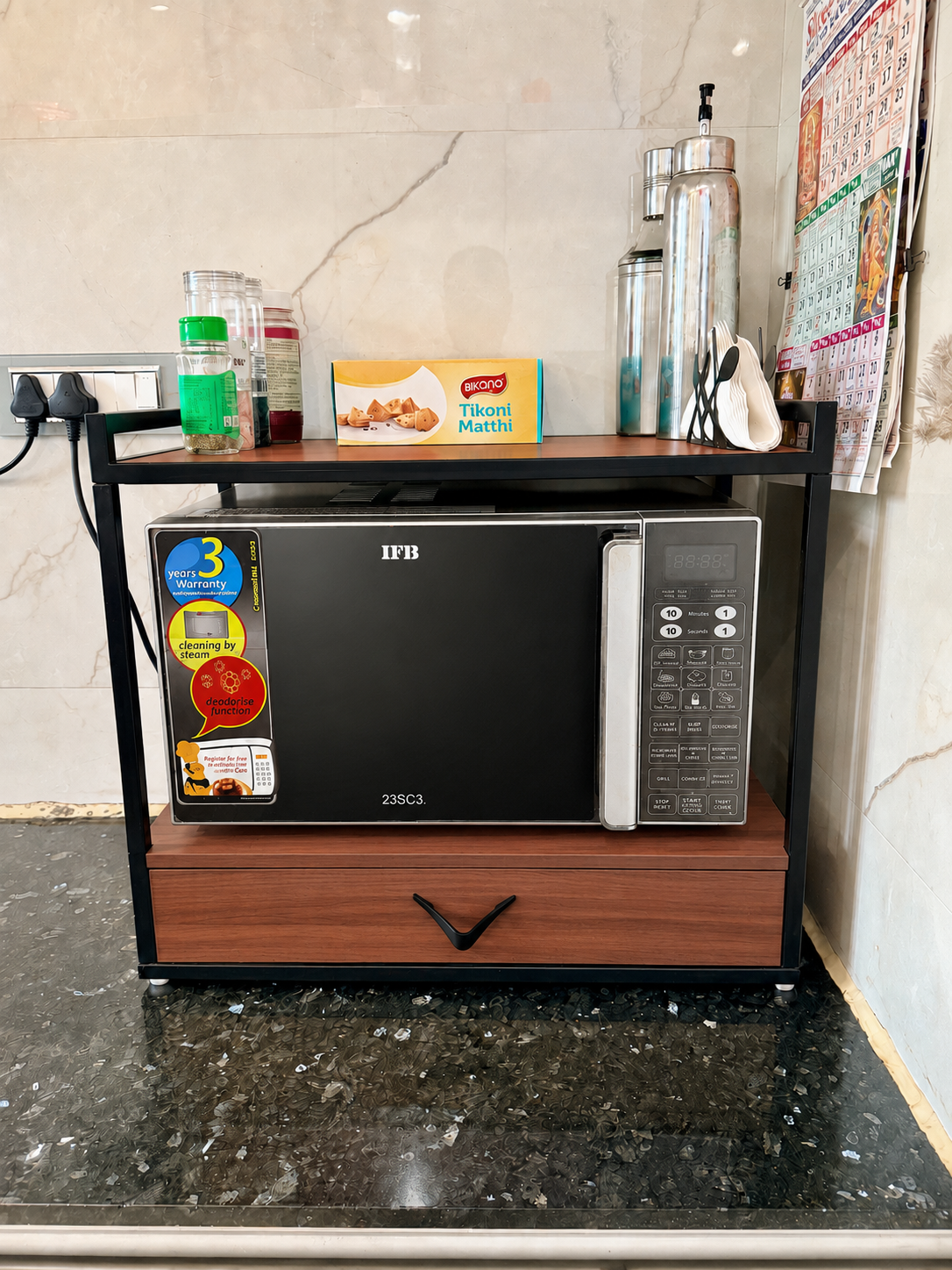
A Practical Example: Sinecraft Creations Microwave Oven Rack
At Sinecraft Creations, our Microwave Oven Rack with Drawer and Top Shelf is designed to combine appliance support with additional kitchen storage.
Instead of functioning only as a microwave platform, the rack offers multiple areas for organising suitable everyday kitchen essentials.
Key features
Powder-coated iron frame: A metal structure with a protective powder-coated finish.
Laminated shelves: Designed to provide practical surfaces for kitchen storage.
Dedicated microwave platform: Approximately 22 inches wide and 14 inches deep.
Additional top shelf: Approximately 21.5 inches long and 14 inches wide.
Built-in drawer: Approximately 19.5 inches wide, 11.5 inches deep, and 3 inches high for organising smaller accessories.
Flat-pack construction: Designed for assembly at home.
Two finish options: Light Oak and Mahogany.
The rack has a stated load capacity of up to 20 kg per shelf, subject to correct assembly, appropriate loading, and the product's usage instructions.
The design can be useful for customers who want to organise their microwave and frequently used kitchen accessories in one dedicated area.
However, customers should always verify their microwave's external dimensions, weight, foot placement, and ventilation requirements before purchasing.
You can explore the Sinecraft Microwave Oven Rack with Drawer and Top Shelf to view the design, dimensions, and available finishes.
Quick Checklist Before Buying a Microwave Stand Online
Before placing your order, run through this simple checklist.
|
What to check |
Question to ask |
|
Frame material |
Is the construction suitable for everyday appliance use? |
|
Weight capacity |
Can the intended shelf safely support my microwave? |
|
Stability |
Is the structure properly supported and designed for its intended load? |
|
Storage |
Will the shelves and drawer be useful for my kitchen? |
|
Dimensions |
Does my microwave fit with the required clearances? |
|
Assembly |
Are instructions and necessary components provided? |
|
Delivery |
Is shipping available to my location, and what does it cost? |
|
Support |
What happens if a part arrives damaged or missing? |
|
Value |
Am I paying for features I will actually use? |
Frequently Asked Questions
1. Is a metal microwave stand better than a wooden stand?
Both can be suitable when properly designed and manufactured. Metal frames are often chosen for structural support, while wooden or engineered wood designs may offer a different appearance. Construction quality, load capacity, moisture resistance, and stability matter more than material alone.
2. Can I place a 23-litre microwave on any microwave stand?
No. Microwave capacity does not determine external dimensions. Always check your microwave's width, depth, height, weight, and ventilation requirements against the stand's specifications.
3. Is a microwave stand with a drawer useful?
Yes, particularly if you need enclosed storage for smaller kitchen accessories. A drawer can help organise items such as oven mitts, measuring spoons, napkins, and other suitable essentials.
4. Can I keep an air fryer or coffee machine on the top shelf?
Only if the shelf is rated to support the appliance and its dimensions, ventilation requirements, operating instructions, and heat clearances permit that placement. Some appliances require substantial free space around them during use.
5. Are flat-pack microwave stands difficult to assemble?
Assembly difficulty depends on the design. Look for clear instructions, labelled components, and an assembly video. Ensure all fasteners are secured correctly before loading the stand.
6. What is the most important thing to check before buying a microwave stand?
Start with compatibility and safety: the stand must accommodate your microwave's dimensions and weight while allowing the ventilation clearances required by its manufacturer. Stability and construction quality are equally important.
Final Thoughts
A microwave stand may seem like a simple kitchen accessory, but choosing the right one can improve how your kitchen functions every day.
Rather than selecting a product based only on its appearance or price, take time to examine its construction, stability, storage features, dimensions, assembly process, and seller support.
A well-chosen microwave stand should fit your appliance properly, make practical use of your available space, and support your daily kitchen routine.
Whether you prefer a basic stand or a microwave rack with a drawer and additional shelf, the right choice is the one that genuinely meets your kitchen's needs.
Measure carefully, compare specifications, and choose a stand that makes your kitchen easier to use—not just better to look at.