Microwave Rack Size Guide: How to Measure Your Microwave Before Buying a Stand
Buying a microwave stand sounds simple until you realise that microwave capacity does not tell you the actual external size of the appliance.
Two 23-litre microwaves can have different widths, depths and heights. One may fit comfortably on a rack while another may be too deep, too wide or too close to surrounding surfaces.
That is why the safest way to choose a microwave rack is not to shop by litre capacity alone. You should measure the actual microwave first.
This guide explains exactly what to measure, what to check before buying a stand and how to avoid the most common fit problems.
Why Microwave Capacity Is Not Enough
Microwaves are usually marketed by internal cooking capacity:
· 20L
· 21L
· 23L
· 25L
· 28L
· 30L and above
But litre capacity tells you about the internal oven cavity. It does not tell you the exact external dimensions.
For example, two microwaves with the same 23-litre capacity can differ because of:
· Control-panel design
· Door thickness
· Internal construction
· Vent placement
· Brand design
· Handle style
· Body proportions
So before buying any microwave stand or rack, check the actual measurements of your appliance.
The 3 Main Measurements You Need
You need three basic measurements: Width × Depth × Height. Measure in inches or centimetres, but stay consistent.
Quick Microwave Measurement Table
|
What to Measure |
How to Measure It |
Why It Matters |
|
Width |
Measure from the far left side to the far right side of the microwave |
Helps confirm the appliance fits within the rack frame |
|
Depth |
Measure from the front edge to the furthest point at the back |
Prevents excessive overhang and helps with stability |
|
Height |
Measure from the base to the highest point on top |
Ensures enough clearance below upper shelves |
|
Feet Position |
Check where all four feet sit underneath the microwave |
All feet should rest securely on the platform |
|
Door Clearance |
Measure how much space the door needs to open fully |
Prevents walls or nearby appliances from blocking access |
|
Ventilation Space |
Check the manufacturer’s required side, rear and top clearance |
Important for safe airflow during use |
|
Cable Reach |
Measure from the microwave to the nearest suitable socket |
Avoids stretched cables and awkward extensions |
|
Available Kitchen Space |
Measure the area where the rack will stand |
Confirms the complete rack fits without blocking movement |
Tip: Write these measurements down before comparing microwave racks online. Do not rely only on the microwave’s litre capacity.
1. Measure the Microwave Width
Width is the distance from the far left side of the microwave to the far right side. Place the measuring tape across the front of the microwave. Measure the complete outer body, not just the door.
· Side panels
· Control panel
· Any body projection
· Fixed handles if they extend sideways
For example, if your microwave measures 19 inches wide, a platform that is exactly 19 inches wide would be too tight. You need some extra room for comfortable placement and access.

2. Measure the Microwave Depth
Depth is especially important because this is where buyers often make mistakes. Measure from the very front of the microwave to the furthest point at the back.
· Rear casing
· Rear projections
· Cable area
· Fixed feet
· Door or handle projection if relevant to positioning
Do not measure only the flat metal body. The microwave must physically sit on the rack without feeling unstable or excessively overhanging.

3. Measure the Microwave Height
Measure from the base of the appliance to the highest point on top. Include any feet or raised sections.
· Upper shelf clearance
· Ventilation
· Easy access
· Ability to clean the top
· Space for opening controls or doors where relevant
The microwave should never feel squeezed between two shelves.

Write the Measurements Down Before Shopping
Once measured, note them like this: Microwave Width: ___ Microwave Depth: ___ Microwave Height: ___. Then compare those numbers with the usable dimensions of the rack. Do not rely on memory. A difference of even an inch can matter.
Measure the Microwave Feet Too
Another detail people often overlook is where the microwave feet sit. The body of a microwave may be wider than the contact points underneath it. Check whether all four feet will sit securely on the rack platform. The microwave should not balance partially on the edge. This becomes especially important when the rack platform is close to the minimum required depth.
Check Where the Microwave Vents Are Located
Microwaves need airflow. Depending on the model, vents may be located on the sides, at the rear, on top, or around multiple surfaces.
Before selecting a rack, check your microwave's user manual for the required clearances. Do not assume that because the microwave fits physically, it is automatically suitable for that location. A rack should allow the appliance to operate according to the manufacturer's ventilation instructions.
Measure the Available Kitchen Space Too
You are not only measuring the microwave. You also need to measure where the rack itself will go.
· Available width: measure the full space between walls, cabinets, refrigerator, kitchen counters and other furniture.
· Available depth: make sure the rack will not block a walkway, interfere with cabinet doors, project awkwardly into the kitchen or restrict access to drawers.
· Available height: check for overhead cabinets, shelves, windows, switchboards and exhaust units.
The rack must fit the room as well as the microwave.
Do Not Forget the Microwave Door
The microwave door needs space to open comfortably. Before buying a stand, check which direction the door opens, whether the handle can be accessed easily, whether a nearby wall blocks the door, and whether another appliance is too close.
A microwave may technically fit on a rack but still be frustrating to use if the door cannot open properly.
Check the Power Point Location
A microwave rack should ideally sit close to a suitable electrical socket. Before choosing the rack position, check cable length, socket height, socket accessibility, plug orientation and whether the cable will be stretched.
Avoid planning the setup first and discovering later that the microwave cable cannot comfortably reach the power point.
Understand the Rack’s Usable Platform Size
When comparing a microwave with a stand, look for the usable platform dimensions, not just the overall outer size of the rack.
For example, a rack may be advertised as 24 inches wide overall, but the actual microwave platform may be slightly smaller because of side frames, support structures, rails or decorative borders. Always compare your microwave dimensions with the surface it will actually sit on.
Leave Some Margin Around the Microwave
A microwave should not be wedged tightly between the rack frame. A little extra room makes it easier to position the appliance, clean around it, access cables, maintain airflow and remove the microwave later.
Exact clearance requirements depend on the microwave model, so always follow the manufacturer guidance.
Microwave Size vs Rack Size: Simple Example
Imagine your microwave measures: Width 20 inches, Depth 13 inches, Height 12 inches. And the rack platform measures: Width 22 inches, Depth 14 inches.
On paper, the microwave may fit. But before buying, you should still check where the feet sit, rear ventilation, side ventilation, cable position, door opening and manufacturer clearance requirements. This is why fit is about more than width alone.
What About 20L and 23L Microwaves?
Many compact and medium-sized microwaves fall into the 20L–23L range. But you should never assume that every 20L or 23L microwave will fit the same stand.
One 23L model may be wider. Another may be deeper. Another may require more ventilation space. So even if a rack is commonly suitable for 20L or 23L microwaves, the safest approach is always: Measure your actual appliance first.
Common Microwave Measuring Mistakes
Mistake 1: Shopping only by litre capacity
“23L microwave” is not a complete size specification. Always check external dimensions.
Mistake 2: Measuring only the front
Depth matters just as much as width.
Mistake 3: Ignoring the feet
The microwave needs secure contact with the platform.
Mistake 4: Forgetting the cable
Rear clearance and socket position can change how far the microwave sits forward.
Mistake 5: Ignoring ventilation
A tight fit is not automatically a good fit.
Mistake 6: Measuring the microwave but not the kitchen
The rack must fit your available space too.
Mistake 7: Not checking the door swing
You need comfortable access to the appliance after installation.
Quick Checklist Before Buying a Microwave Rack
· Microwave width measured
· Microwave depth measured
· Microwave height measured
· Microwave feet checked
· Vent locations checked
· Manufacturer clearance requirements checked
· Door opening space checked
· Cable length checked
· Power socket location checked
· Rack platform width checked
· Rack platform depth checked
· Kitchen space measured
· Walkway clearance checked
· Upper shelf clearance checked
If all of these work, you are much less likely to face fit problems after delivery.
Should the Microwave Overhang the Rack?
Ideally, the microwave should sit securely on the platform. A small body projection does not necessarily mean the feet are unsupported, but you should never assume overhang is safe.
· Are all microwave feet securely supported?
· Is the rack stable?
· Does the appliance manufacturer allow the setup?
· Is ventilation unaffected?
If you are unsure, avoid forcing the fit.
What Else Should You Check in a Microwave Stand?
Weight capacity
The rack should comfortably support the microwave.
Stability
A microwave is a relatively heavy everyday appliance, so the rack should feel secure.
Shelf depth
Enough depth helps the appliance sit properly.
Extra storage
A top shelf or drawer can reduce counter clutter.
Material
Metal frames are commonly chosen for strength and long-term everyday use.
Assembly
If the rack ships flat-pack, check that assembly is straightforward.
A Rack Can Do More Than Hold a Microwave
Once you choose the correct size, a microwave rack can become a useful kitchen appliance station. You may be able to organise:
· Microwave
· Electric kettle
· Toaster
· Tea or coffee containers
· Oven mitts
· Serving accessories
· Small kitchen essentials
This is particularly useful in small Indian kitchens where counter space is limited. Instead of spreading appliances across multiple surfaces, one dedicated area can keep the kitchen more organised.
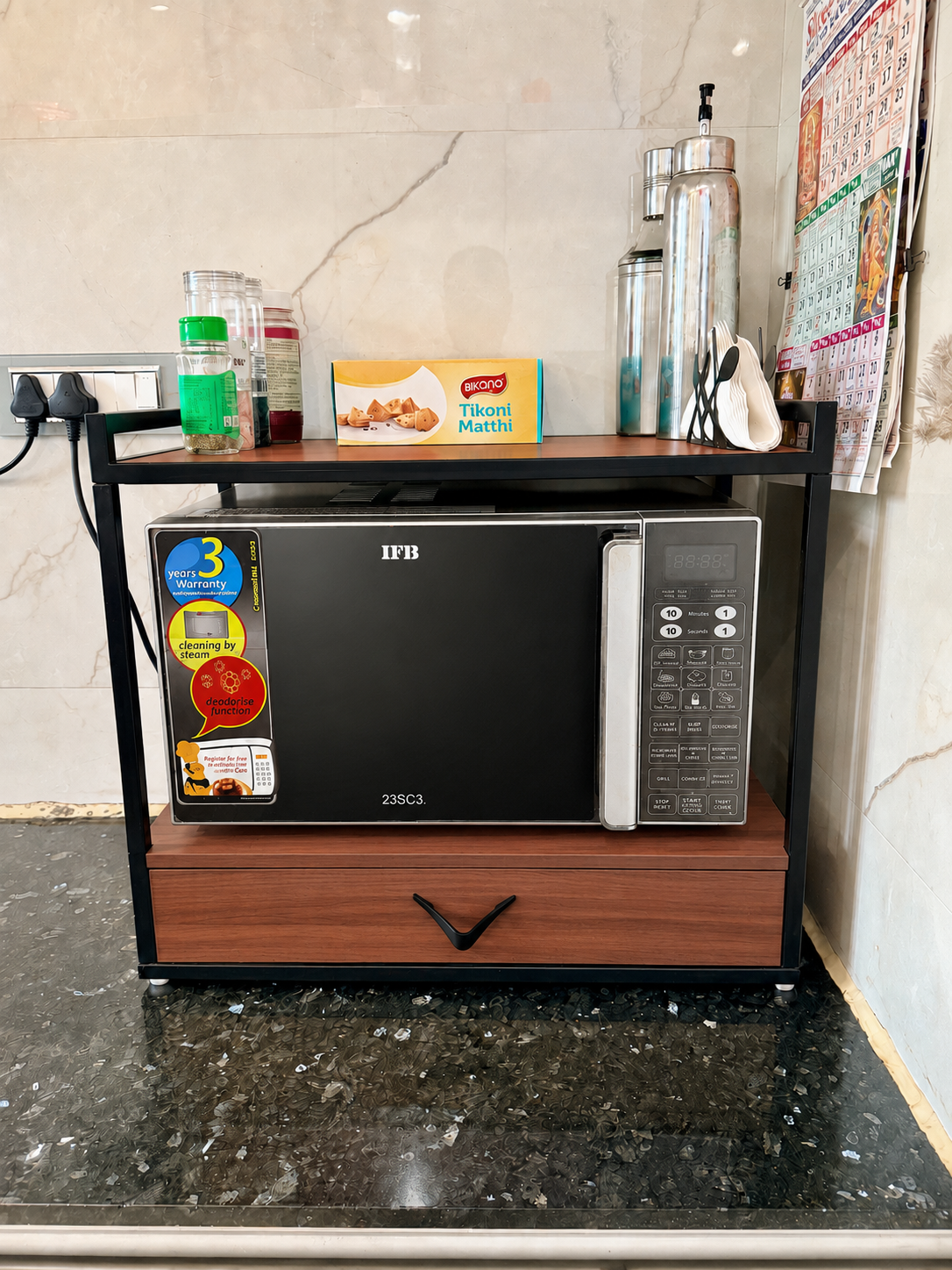
Checking Fit With the Sinecraft Microwave Oven Rack
The Sinecraft Creations Microwave Oven Rack with Drawer and Top Shelf is designed for compact kitchen appliance organisation.
The microwave platform is approximately 22 inches wide × 14 inches deep. The platform height is approximately 14.5 inches.
The rack also includes:
· Powder-coated iron frame
· Top storage shelf
· Spacious drawer
· Flat-pack construction
· Multi-purpose appliance storage
The rack has been used successfully with compatible 20L–23L microwaves, but microwave dimensions vary by brand and model. So before ordering, compare your actual microwave measurements with the rack dimensions. Do not rely only on litre capacity.
A Simple Rule to Remember
Measure the microwave first. Measure the rack second. Compare both. Then check ventilation.
That simple process can prevent most fit-related problems.
Final Thoughts
Choosing the right microwave rack is not complicated, but it does require proper measurement. The biggest mistake is assuming that all microwaves with the same litre capacity have the same dimensions. They do not.
Measure: Width. Depth. Height. Then check: Feet. Ventilation. Door opening. Power point. Rack platform. Kitchen space.
A microwave stand should not only fit your appliance. It should make the appliance easier to use, keep the kitchen organised and give you confidence that the setup works comfortably in your space.
Measure first. Buy once. Organise better.