How to Organise Your Indian Kitchen Counter Without a Renovation 9 Practical Tips That Work in Every Indian Home
Share
The Indian kitchen counter is one of the hardest working surfaces in any home. It holds the pressure cooker, the masala dabba, the chopping board, the dish soap, the utensil stand, the tissue roll, the oil bottle, whatever was used in the last meal and not yet put away, and at least three things that do not belong in the kitchen at all.
The result is a counter that looks perpetually chaotic — even right after cleaning. Items multiply faster than they are organised. Surfaces shrink as things accumulate. And the idea of doing something about it feels like it would require a full kitchen renovation, new cabinets, or at minimum a free weekend and a lot of patience.
It does not. Organising an Indian kitchen counter is entirely possible without drilling a single hole, buying a single new cabinet, or spending more than an afternoon. What it requires is a system — a clear set of decisions about what belongs on the counter, where it lives, and what contains it.
Here are 9 practical tips specifically designed for Indian kitchen counters in 2026 — based on how Indian kitchens actually work, not how Western organisation guides imagine they do.
The same principles that make a living room surface look styled and organised apply directly to your kitchen counter. Read our guide on how to style every surface in your Indian home with wooden tray combos for the broader picture — then come back and apply it specifically to the kitchen.
Tip 1 — Do the Counter Audit First
Before buying a single organiser or moving anything around, do one thing — take everything off your kitchen counter completely. Every single item. The pressure cooker, the masala dabba, the utensil stand, the random jars, everything. Place it all on the dining table or the floor.
Now look at your empty counter. This is the surface you are working with. Every item you put back needs to earn its place.
Sort everything into three groups:
• Used daily — these items can go back on the counter. Masala dabba, one utensil stand, one chopping board, dish soap, tissue.
• Used weekly — these belong in a cabinet or drawer, not on the counter. Mixer jar attachments, baking trays, extra bowls.
• Does not belong in the kitchen — return these to their correct home. Phone chargers, bills, medicine strips, keys, children's toys.
Most Indian kitchen counters immediately look 40% more organised after this audit alone — before a single organiser is purchased or installed. The problem is almost never a lack of storage. It is too many things living on the counter that should be elsewhere.
The goal is not an empty counter — it is a counter where every visible item has a permanent home and a reason to be there. Start with the audit and you will be surprised how much space you already have.
Tip 2 — Give the Masala Station a Permanent Home
The masala dabba is the heart of the Indian kitchen — and it is also the biggest counter organisation challenge. A traditional steel masala box is bulky, heavy, and takes significant counter space. When it is not in use it just sits there, dominating the surface.
The solution is to create a dedicated masala station — a defined zone on the counter where the masala box lives permanently, alongside the items it is always used with. A small wooden tray containing the masala box, a set of wooden spoons, and a small salt container creates a zone that is both functional and visually beautiful.
A sheesham wood masala box is especially effective for this — the warm wood finish looks intentional on a kitchen counter in a way that a steel box simply does not. It transforms the masala station from a utilitarian necessity into a genuine design element.
Sinecraft Tip: Our Sheesham Wood Masala Box with its 8x8 inch footprint fits perfectly on most Indian kitchen counters. Place it on one of our wooden serving trays alongside the Neem Wood Kitchen Utensils Set and you have a complete, beautiful masala station that takes up exactly the same space as your steel dabba — but looks ten times better. Browse our Serving Tray Combos for ready-made kitchen station sets.
Tip 3 — Contain Everything With a Tray
The single most effective counter organisation tool is not a drawer insert, not a cabinet organiser, not a wall-mounted rack. It is a tray. A tray on the kitchen counter creates a defined boundary — everything inside the tray belongs together, everything outside it is either clear counter space or something that does not belong.
In an Indian kitchen the tray system works like this: one tray for the masala and cooking essentials, one tray for the dish soap and cleaning items near the sink, and the rest of the counter stays completely clear. This two-tray system contains the inevitable daily accumulation of items while keeping the visual impression of the counter clean and organised.
The key is to choose trays that are beautiful enough to be left on display permanently. A cheap plastic tray signals clutter even when it is organised. A handcrafted wooden tray signals intention — the items inside it look curated, not abandoned.
Sinecraft Tip: Our Serving Tray Combos include tray sets paired with brass inlay jars, wooden bowls, and neem spoons — specifically curated to create a beautiful, functional kitchen counter station out of the box. No additional styling or sourcing required.
Tip 4 — Sort Your Utensils — One Stand, Not Three
Most Indian kitchen counters have two or three utensil stands overflowing with spatulas, ladles, spoons, whisks, and tongs — most of which are rarely used. Every utensil that does not need to be on the counter is taking valuable surface space and adding visual noise.
The rule is simple — one utensil stand on the counter, containing only the 5 to 7 utensils used daily. Everything else goes in a drawer. For most Indian cooking that means one large ladle, one slotted spoon, one spatula, one pair of tongs, and one or two wooden spoons.
A wooden or natural material utensil holder looks significantly better than a steel cylinder and coordinates beautifully with wooden trays, masala boxes, and chopping boards to create a cohesive natural material aesthetic on the counter.
Sinecraft Tip: Our Pinewood Cutlery Holder at 10x5 inches holds the right number of daily utensils without overcrowding — and the pinewood finish coordinates naturally with our sheesham masala box, neem spoons, and wooden trays for a consistent counter aesthetic.
Tip 5 — Upgrade Your Chopping Board Setup
The chopping board is one of the most used items in the Indian kitchen — and one of the most counter space inefficient when stored flat. A chopping board lying flat on the counter takes up its full footprint even when not in use. Standing it upright takes almost no space at all.
The best approach for Indian kitchen counters is to store the chopping board upright against the backsplash wall or inside a tray, making it instantly accessible but taking up a fraction of the counter space. A beautiful chopping board stored upright also becomes a visual element rather than a utilitarian object lying in the way.
For Indian kitchens in 2026, bamboo and hardwood chopping boards are replacing plastic — and for good reason. They are more durable, naturally antimicrobial, kinder to knife edges, and significantly more beautiful on the counter. A bamboo board with a steel handle leans beautifully against the backsplash and looks like it belongs there.
Sinecraft Tip: Our Bamboo Chopping Board 12x8.5 inches with Steel Handle is sized perfectly for Indian meal prep — large enough for vegetables and rotis, compact enough to store upright beside the counter tray without taking floor space. The steel handle makes it easy to pick up, move, and clean.
Tip 6 — Use Vertical Space Above the Counter
Most Indian kitchen organisation focuses entirely on the counter surface — but the wall space above it is almost always completely unused. A 60 centimetre wide, 45 centimetre tall section of backsplash wall above the counter can hold a wall-mounted spice rack, a magnetic knife strip, a paper towel holder, or a small shelf — all without using a single inch of counter space.
The most practical vertical additions for Indian kitchen counters:
• Wall-mounted spice rack — moves the small spice bottles off the counter completely, accessible at eye level while cooking
• Magnetic knife strip — removes the knife block from the counter, keeps knives accessible and safely stored
• Under-cabinet hooks — hang ladles, spatulas, and lightweight utensils under wall cabinets, freeing the utensil stand for only the most-used items
• Small floating shelf — adds a second surface tier above the counter for items that are accessed but not used during active cooking
Every item that moves from the counter surface to the wall above it frees up counter space without requiring any new storage furniture. Start with the spice bottles — they are usually the biggest counter space wasters in Indian kitchens.
Tip 7 — Handle the Appliance Problem
Kitchen appliances are the biggest counter space challenge in modern Indian homes. The mixer grinder, the air fryer, the toaster, the electric kettle, the microwave — each one is heavy, bulky, and inconvenient to move in and out of cabinets. So they live on the counter permanently, consuming a significant portion of the available surface.
The realistic approach — not the aspirational magazine approach — for Indian kitchens:
• Keep only the appliances used daily on the counter. For most Indian households that is the mixer grinder and the electric kettle. Everything else goes in a cabinet.
• Group appliances together in one zone — typically near the power socket. Appliances scattered across different parts of the counter fragment the space visually and make it harder to keep clean.
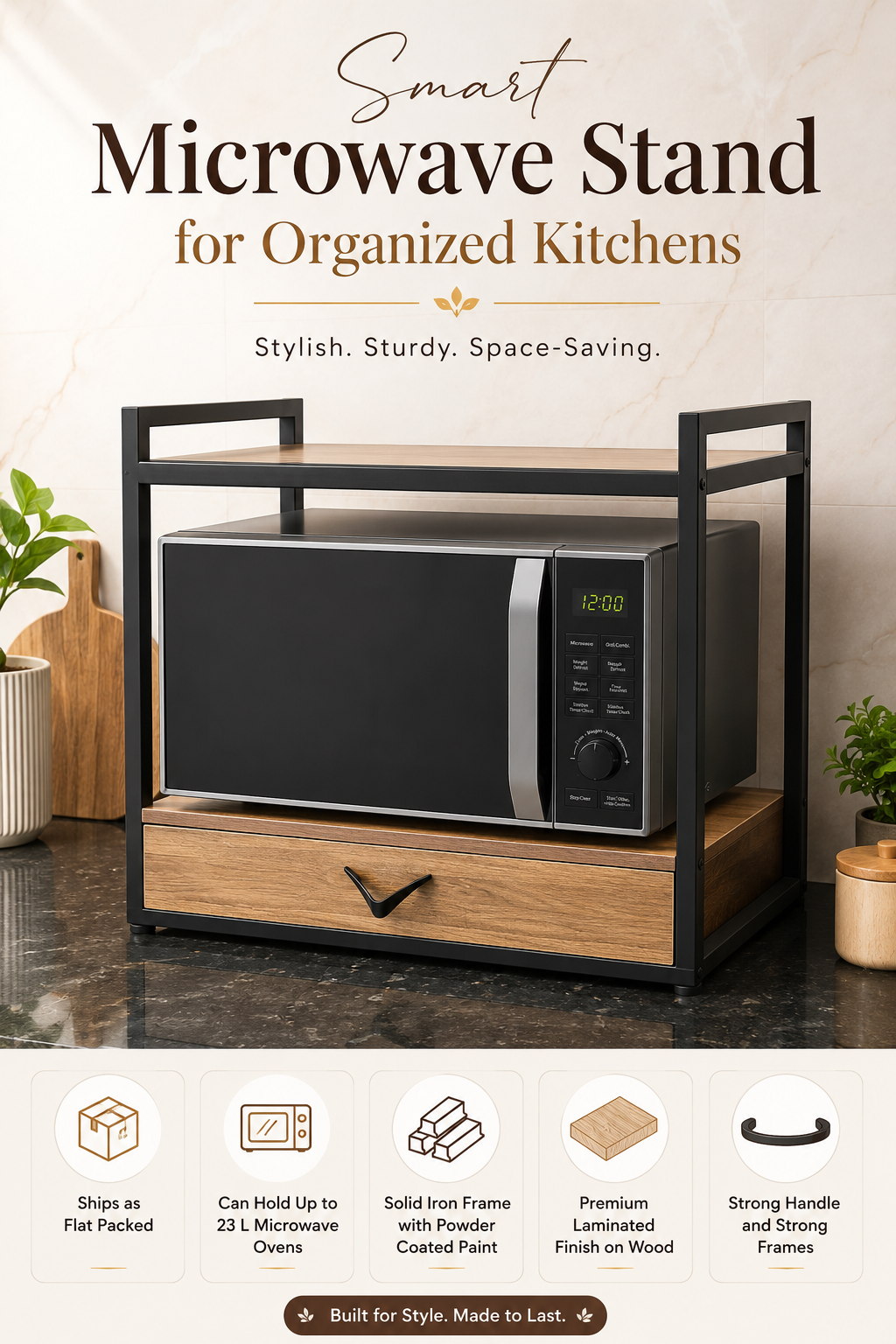
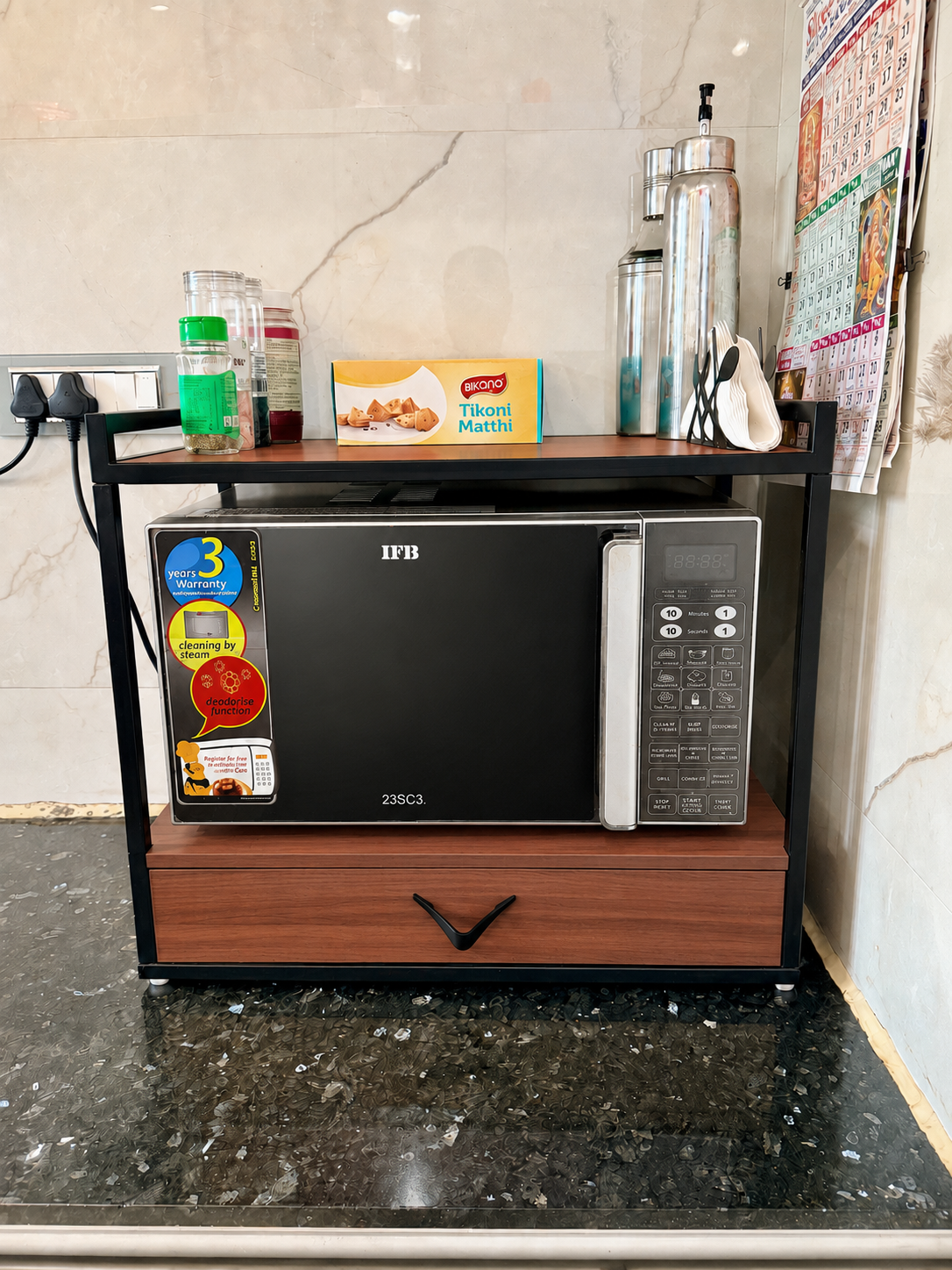
• Use a microwave stand or appliance trolley to move the microwave off the counter entirely — it reclaims significant surface space and the trolley itself becomes a functional kitchen element
• Small appliances like toasters and sandwich makers that are used only occasionally should never live on the counter — they go in a cabinet and come out when needed
The discipline of keeping only daily-use appliances on the counter is what separates organised Indian kitchens from chaotic ones — because once one non-daily appliance gets counter space, others quickly follow.
Tip 8 — Create a Natural Materials Aesthetic
This is the tip that transforms an organised kitchen into a beautiful one. Organisation removes the chaos. A consistent material aesthetic adds the visual calm that makes a kitchen feel genuinely pleasant to spend time in.
In Indian kitchens in 2026 the strongest counter aesthetic is natural materials — wood, bamboo, brass, and terracotta — replacing the mix of steel, plastic, and random colours that most counters currently display. When every item on the counter is in the same material family, the counter looks cohesive even when it is fully loaded with the day's cooking essentials.
How to build a natural materials kitchen counter aesthetic:
• Replace steel masala box with sheesham or teak wood masala box
• Replace plastic utensil stand with pinewood or bamboo holder
• Replace plastic chopping board with bamboo or hardwood board
• Replace random plastic containers with brass or sheesham wood jars for dry goods
• Add a wooden tray as the counter anchor — it ties all the natural materials together visually
You do not need to replace everything at once. Start with one or two pieces and add over time. Even two wooden items among otherwise mixed materials immediately shifts the counter aesthetic toward something more considered and warm.
Sinecraft Tip: Our complete kitchen natural materials range — Sheesham Wood Masala Box, Pinewood Cutlery Holder, Bamboo Chopping Board, Neem Wood Utensils Set, and Sheesham Wood Bowls — are all designed to work together aesthetically. Available individually or in curated sets via our Serving Tray Combos collection.
Tip 9 — Do the 2-Minute Reset Every Evening
Organisation systems only work if they are maintained. The biggest reason Indian kitchen counters revert to chaos within days of being organised is that there is no daily reset habit — things land on the counter and stay there.
The 2-minute evening reset is the habit that makes every other tip in this guide sustainable. Every evening after dinner, spend exactly two minutes returning every item on the counter to its designated place. Anything that does not have a place goes either in a cabinet or out of the kitchen entirely.
Two minutes is genuinely enough because an organised counter with a proper system resets almost instantly — each item has a home and returning it takes seconds. The reset is only long and difficult when there is no system, which is why the preceding eight tips matter.
An organised kitchen counter is not a one-time achievement — it is a daily practice. Two minutes every evening is all it takes to maintain a system that transforms how your kitchen looks and feels every single morning.
Your Kitchen Counter Organisation Checklist
|
Action |
Impact |
Time Needed |
|
Do the full counter audit |
Immediate 40% declutter |
30 minutes |
|
Create dedicated masala station |
Biggest visual anchor on counter |
10 minutes |
|
Add one tray to contain essentials |
Instant organisation without effort |
5 minutes |
|
Reduce to one utensil stand |
Removes visual noise immediately |
5 minutes |
|
Store chopping board upright |
Frees significant counter space |
2 minutes |
|
Move non-daily appliances to cabinet |
Largest space gain possible |
15 minutes |
|
Switch to natural material accessories |
Transforms aesthetic over time |
Gradual |
|
Start 2-minute evening reset habit |
Maintains system long term |
2 min/day |
Final Thoughts
The Indian kitchen counter is never going to be empty — nor should it be. It is a working surface in one of the busiest rooms in the home and it needs to hold the essentials of daily cooking. The goal is not minimalism for its own sake. The goal is organised functionality — every item has a place, every zone has a purpose, and the overall impression is one of calm intention rather than accumulated chaos.
Start with the audit. Remove everything and be ruthless about what earns its place back. Create a masala station with a tray. Reduce to one utensil stand. Store the chopping board upright. Move non-daily appliances to cabinets. Add one or two natural material pieces to anchor the aesthetic. And reset for two minutes every evening.
No renovation. No new cabinets. No carpenter required. Just a system, a few beautiful pieces, and the discipline to maintain it.
Shop natural wood kitchen essentials at sinecraftcreations.com | Free Shipping Across India | Same Day Delivery in Delhi NCR