Air Fryer Storage Ideas for Small Indian Kitchens
Share
Air fryers have quickly become one of the most useful appliances in modern Indian kitchens.
They are convenient for reheating snacks, roasting vegetables, making quick evening food and preparing lighter versions of fried dishes. But there is one problem many kitchens run into almost immediately:
Where do you keep the air fryer when counter space is already limited?
Most Indian kitchens were not originally designed with space for multiple countertop appliances. Once you add a microwave, mixer grinder, electric kettle, toaster and air fryer, the main counter can become crowded very quickly.
The good news is that an air fryer does not necessarily need to permanently occupy your main preparation area.
With better zoning, vertical storage and a little planning, you can keep your air fryer accessible without making the kitchen feel cramped.
Why Air Fryer Storage Can Be Tricky
An air fryer is compact compared with a full oven, but it still needs a reasonable amount of space.
Unlike smaller appliances such as a toaster, an air fryer usually has:
- A wide body
- A pull-out basket
- Ventilation requirements
- A power cable
- Heat-generating components
- A front-access drawer or basket
This means you cannot simply squeeze it into any empty corner.
The storage location needs to be:
- Easy to reach
- Stable
- Close to a suitable power point
- Large enough for the appliance
- Open enough for safe use
- Convenient for pulling out the basket
The best storage solution therefore depends on how often you use the air fryer.
1. Keep It on the Counter Only if You Use It Frequently
If your air fryer is used almost every day, keeping it on the counter may still be the most practical option.
The key is to avoid placing it in the middle of your main food-preparation zone.
A better position is usually:
- At one end of the counter
- Near a wall
- Close to a power socket
- Away from the main chopping and preparation area
This keeps the appliance accessible without allowing it to dominate the entire work surface.
If the air fryer is only used once or twice a week, however, permanent counter space may not be justified.
2. Create a Dedicated Appliance Zone
Instead of placing appliances wherever there happens to be space, group them into one defined area.
For example, you could create a kitchen appliance zone containing:
- Air fryer
- Microwave
- Electric kettle
- Toaster
- Coffee machine
This makes the kitchen look much more organised because the appliances are visually contained in one section rather than spread across several parts of the counter.
It also makes everyday use easier because similar appliances are stored together.
3. Use Vertical Storage to Free Up Counter Space
One of the most effective ways to organise an air fryer in a small kitchen is to use vertical storage.
A multi-level kitchen rack can create additional appliance storage without increasing the footprint dramatically.
For example:
Upper shelf: kettle, toaster or lightweight containers
Main shelf: microwave
Separate accessible shelf or nearby platform: air fryer
Drawer: accessories, liners, mitts and small kitchen items
The exact arrangement depends on the dimensions and ventilation requirements of each appliance.
The main advantage is that several appliances can be consolidated into one organised station instead of occupying separate sections of the kitchen.
4. Avoid Placing the Air Fryer Directly on Top of Another Appliance
When space is limited, it can be tempting to place the air fryer directly on top of a microwave or another appliance.
This is not a good general storage strategy.
Air fryers generate heat and need ventilation while operating. Other appliances may also have vents or surfaces that are not designed to support additional equipment.
Instead of stacking appliances directly, use a dedicated shelf between them.
This gives each appliance its own level and makes cleaning and access much easier.
Always follow the manufacturer's instructions for clearance and ventilation.
5. Use a Freestanding Kitchen Rack
A freestanding rack can work especially well when your built-in kitchen does not have enough appliance space.
This is useful for:
- Rental homes
- Compact apartments
- Older kitchens
- Homes where renovation is not practical
- Kitchens with limited counter length
A rack allows you to create storage without changing cabinetry.
It can also be repositioned if your kitchen layout changes later.
For an air fryer, choose a rack with:
- A stable structure
- A shelf large enough for the appliance
- Enough depth
- Easy access from the front
- Suitable weight capacity
- Open space around the appliance
6. Keep the Air Fryer Near a Power Point
Air fryers are high-power appliances, so storage and electrical planning should go together.
Avoid placing the air fryer in a location where you constantly need to stretch the cable across the counter.
A better setup keeps the appliance close to a suitable wall socket.
Before selecting the location, check:
- Cable length
- Plug position
- Socket accessibility
- Whether the appliance needs its own socket
- Whether other high-power appliances are being used nearby
Avoid overloading extension boards.
Use the electrical setup recommended by the air fryer manufacturer.
7. Make Sure the Basket Can Open Fully
One of the easiest mistakes to make is choosing a storage shelf that technically fits the body of the air fryer but does not leave enough space to pull out the basket.
Before finalising the location, check:
- Appliance depth
- Basket extension
- Handle clearance
- Space in front of the shelf
- Whether a cabinet door or wall blocks access
You should be able to remove the basket comfortably without moving the entire appliance every time.
This is particularly important in narrow kitchens.
8. Use Lower Cabinets for Occasional-Use Air Fryers
If you use the air fryer only occasionally, a lower kitchen cabinet may be a better option than the counter.
This keeps the kitchen visually clean while still allowing the appliance to remain relatively accessible.
The trade-off is that air fryers can be fairly heavy.
If you choose this option, store it on a shelf that does not require awkward lifting.
Avoid placing a heavy air fryer too high or too low if it becomes difficult to move safely.
9. Use a Pull-Out Appliance Shelf if You Have Modular Cabinets
Some modular kitchens have pull-out platforms designed for appliances.
These can be useful because the appliance stays hidden when not in use and can be pulled forward when required.
This works particularly well for:
- Mixer grinders
- Toasters
- Coffee machines
- Air fryers
However, make sure the pull-out shelf is designed to support the weight and dimensions of the appliance.
Ventilation should also be considered carefully before operating an air fryer inside any enclosed cabinet area.
10. Keep Air Fryer Accessories Together
Air fryer storage becomes messy when the appliance is in one place and the accessories are scattered elsewhere.
Try to keep related items nearby.
These may include:
- Silicone liners
- Baking paper
- Tongs
- Heat-resistant gloves
- Cleaning brushes
- Small trays
- Skewers
- Recipe booklets
A drawer below or beside the appliance station is ideal.
This creates one complete air fryer zone rather than forcing you to search through different cabinets every time you use it.
11. Use a Tray or Basket for Smaller Accessories
A simple serving tray or storage basket can help keep loose accessories organised.
You can group together:
- Liners
- Oil spray
- Tongs
- Seasoning jars
- Small bowls
- Cleaning cloths
Instead of several small objects spreading across the counter, they become one movable group.
This also makes cleaning the area much easier.
12. Keep the Air Fryer Away From Water Sources
Avoid placing the air fryer too close to:
- Sink edges
- Water purifier outlets
- Wet preparation areas
- Dish-drying zones
Electrical appliances are easier to manage when they have a dedicated dry area.
In small kitchens, this may require rearranging appliance zones so that cooking appliances remain separate from washing areas.
13. Do Not Use Enclosed Storage While the Air Fryer Is Running
An air fryer may be stored inside a cabinet when not in use, but it should not automatically be assumed that it can safely operate there.
The appliance releases heat and needs appropriate airflow.
If you store it inside a cabinet:
- Pull it out before use if required
- Follow the manufacturer's clearance recommendations
- Do not block air vents
- Do not operate it in a tightly enclosed space unless specifically permitted
This is one of the most important differences between storing an appliance and using it.
14. Measure Before Buying a Rack
Do not choose storage based only on the air fryer's litre capacity.
A 4-litre air fryer from one brand can have very different external dimensions from another 4-litre model.
Measure:
- Width
- Depth
- Height
- Basket extension
- Cable location
- Vent position
Then compare those measurements with the shelf or rack you plan to use.
This helps avoid buying a storage unit that looks suitable online but does not work comfortably in your kitchen.
15. Keep Some Empty Space Around the Appliance
The goal of organisation is not to pack every available shelf as tightly as possible.
Leave breathing room.
You should be able to:
- Pull the basket out
- Wipe around the appliance
- Access controls
- Reach the power switch
- Move the air fryer if needed
- Allow airflow
An appliance station usually looks more organised when it is not completely filled.
Where Should You Keep an Air Fryer in a Small Kitchen?
For most small kitchens, the best location is usually one of these:
Option 1: End of the kitchen counter
Best for people who use the air fryer almost every day.
Option 2: Dedicated appliance rack
Useful when you have several appliances and limited horizontal counter space.
Option 3: Freestanding utility shelf
Suitable for rental homes and kitchens where cabinetry cannot be modified.
Option 4: Lower cabinet
Better for occasional-use appliances.
Option 5: Pull-out modular shelf
Useful where the kitchen already includes dedicated appliance storage.
There is no single correct location.
The right choice depends on how frequently the appliance is used and how your kitchen is laid out.
Example of a Small Kitchen Appliance Station
Imagine you have:
- Microwave
- Air fryer
- Electric kettle
- Toaster
Keeping all four side by side can consume a large portion of the counter.
Instead, you could create an appliance station.
Upper shelf
Electric kettle and toaster
Main platform
Microwave
Nearby accessible shelf or counter section
Air fryer
Drawer
Air fryer liners, oven mitts, microwave accessories and smaller items
This keeps the appliances within one defined zone while leaving the main preparation counter more open.
Can You Keep an Air Fryer on a Microwave Rack?
Potentially, yes, provided the rack is suitable for the appliance and the setup follows the air fryer's operating requirements.
Before doing so, check:
- Shelf dimensions
- Weight capacity
- Stability
- Air fryer dimensions
- Ventilation requirements
- Space for basket removal
- Distance from walls and nearby objects
- Power socket position
You should never assume that any shelf is automatically suitable simply because the air fryer physically fits.
The appliance manufacturer's instructions should always take priority.
Turning a Microwave Rack Into a Multi-Appliance Station
A microwave rack does not necessarily need to be used only for a microwave.
A well-designed multi-level rack can help organise several everyday kitchen essentials within one compact zone.
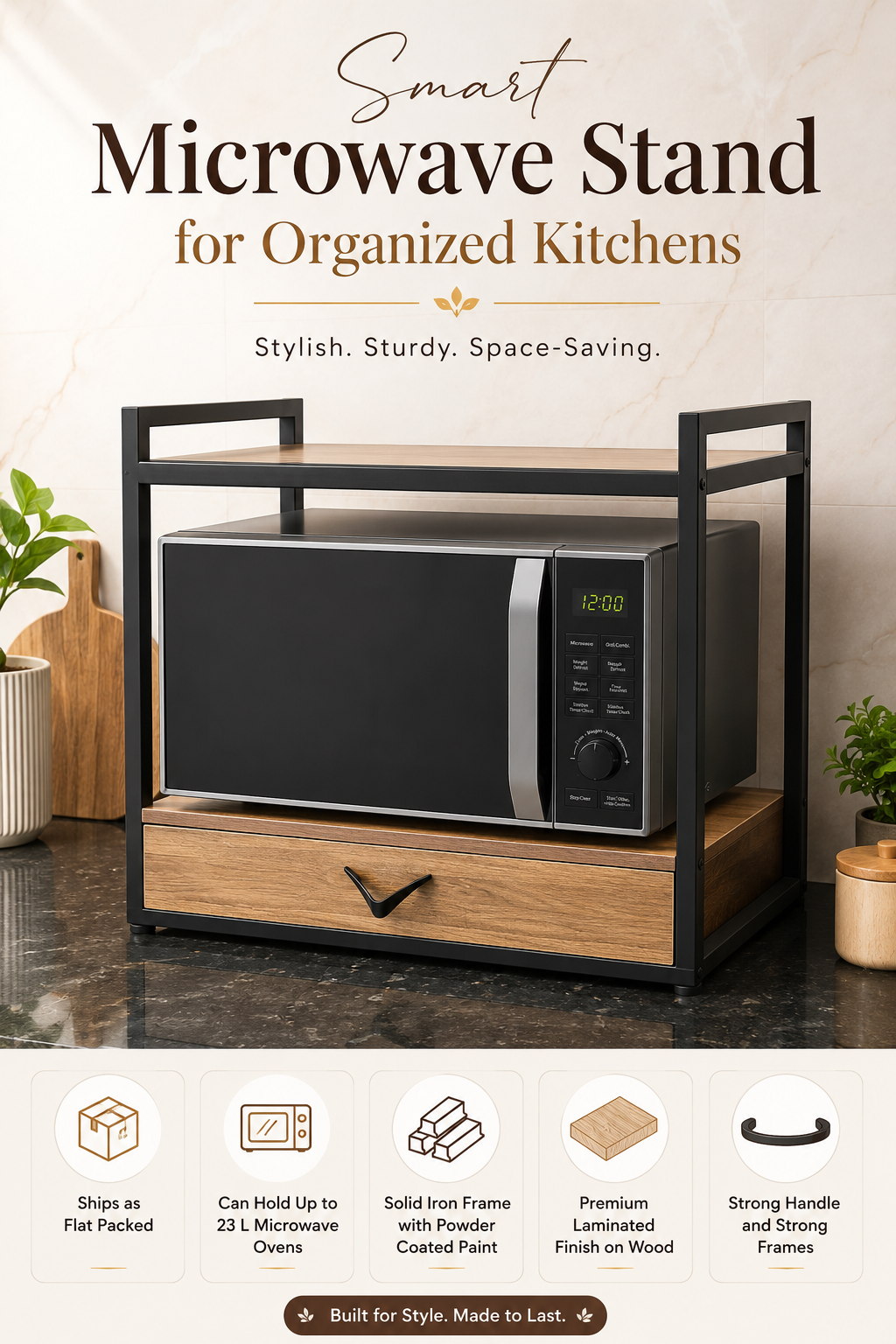
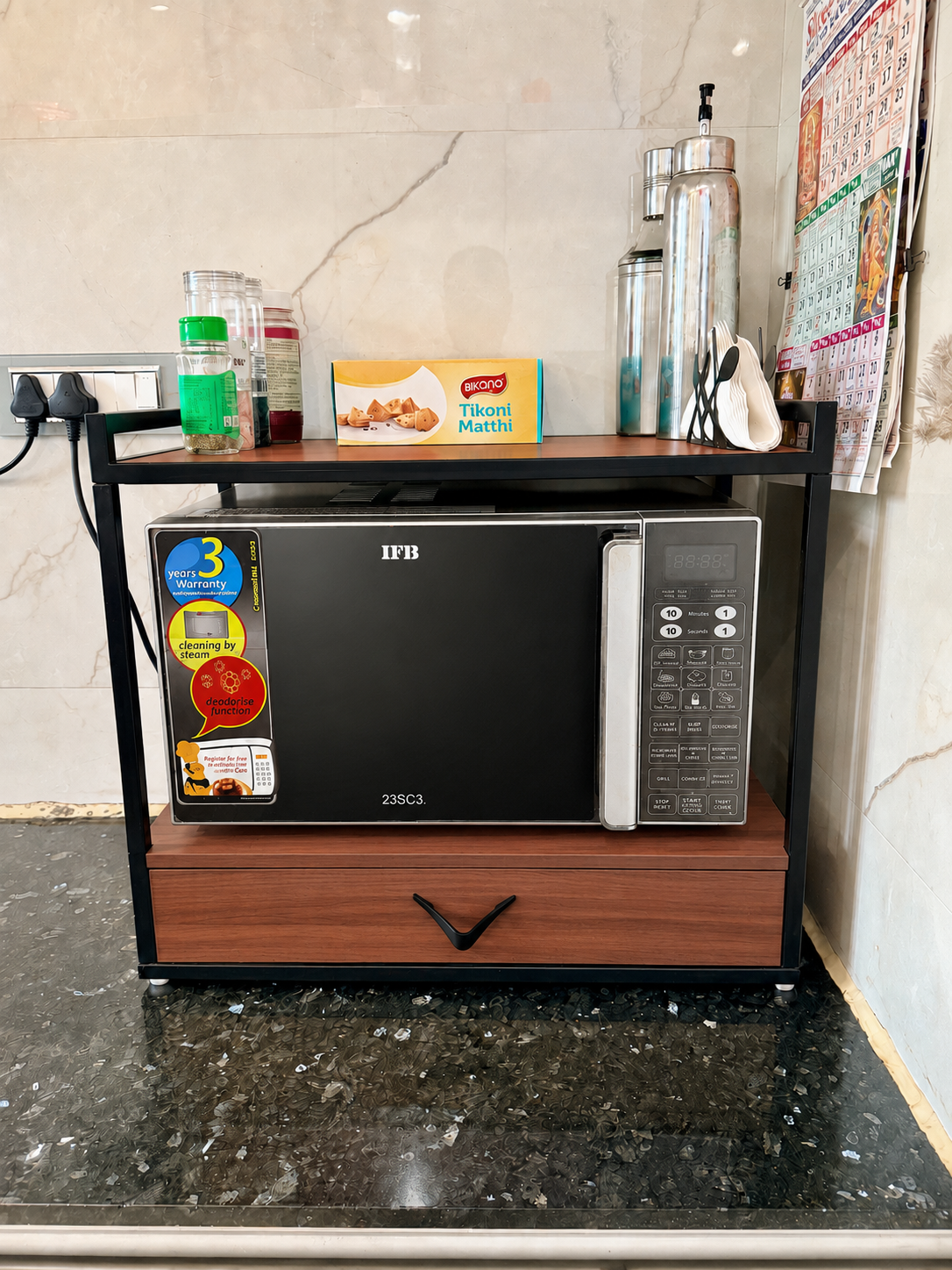
For example, the Sinecraft Creations Microwave Oven Rack with Drawer and Top Shelf provides separate levels for appliance and accessory storage.
The main platform can hold a compatible microwave, while the upper shelf can be used for lightweight appliances or everyday kitchen items such as a kettle, toaster, containers or serving accessories.
The drawer can keep smaller accessories out of sight.
An air fryer may also be incorporated into the broader appliance zone depending on its dimensions, weight, ventilation needs and the specific kitchen setup.
Always measure first and follow the appliance manufacturer's operating instructions.
Final Thoughts
The best air fryer storage solution is not necessarily the one that hides the appliance.
It is the one that keeps your kitchen practical.
If you use your air fryer every day, keep it accessible.
If you use it occasionally, free up the counter and store it elsewhere.
Group appliances into dedicated zones.
Use vertical space instead of spreading everything sideways.
Keep accessories together.
Measure carefully before buying storage.
And make sure the air fryer has enough space to be used safely and comfortably.
In a small kitchen, good organisation is less about having more storage and more about using the available space intelligently.